Three Types of AI Agents
A practical taxonomy from conversational support to delegated tasks and organizational workflows.
Why a Taxonomy Is Useful
In conversations about AI agents, I often notice that very different systems are discussed under the same label. A conversational assistant in a browser, a coding agent working in a repository, and an automation workflow that reacts to incoming customer requests can all be called “agents”. This is not entirely wrong, but it is also not very helpful if we want to understand what kind of system we are actually buying, building, deploying, or governing.
The term AI agent is used in different ways. In this article, I use it pragmatically: an AI agent is a system in which a language model is connected to context, memory, tools, and control logic so that it can help pursue a goal beyond producing a single text response. This does not mean that the agent is fully autonomous. In most useful systems, autonomy is bounded by user instructions, available tools, permissions, budgets, and review steps.
At the architectural level, the basic pattern is relatively stable, as shown in Figure 1. The model receives instructions and a goal, retrieves or updates context through memory, and acts through tools or APIs. The result is not a single model call, but a loop in which the system reasons, acts, observes the result, and continues until the goal is reached or a stop condition applies.
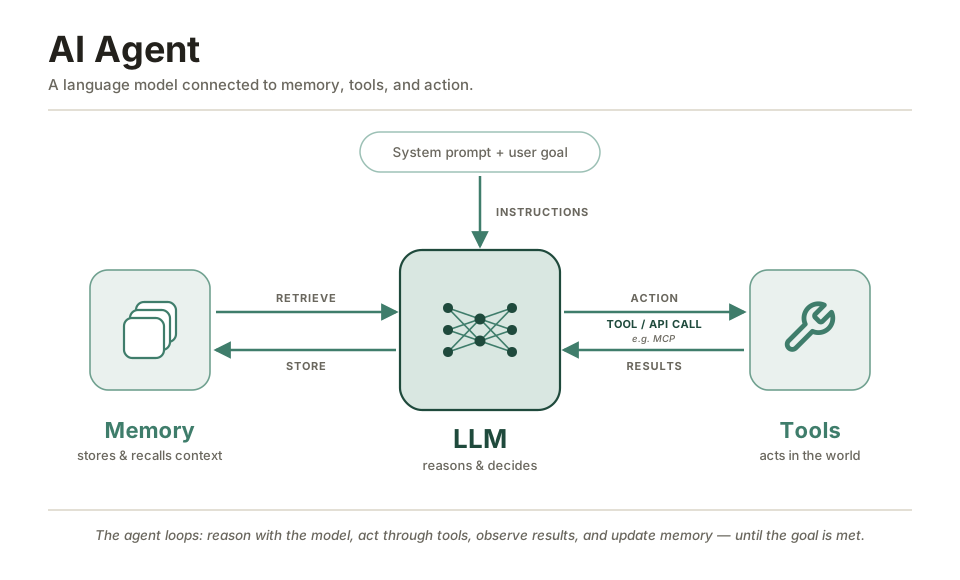
Research and engineering work on LLM-based agents often emphasizes recurring components such as planning, memory, tool use, interaction with an environment, and evaluation (Wang et al. 2023; Yao et al. 2022). Current developer frameworks make the same pattern visible in practice. OpenAI (2026), for example, describes agents as language models equipped with instructions and tools, and adds concepts such as guardrails, sessions, handoffs, tracing, and human-in-the-loop mechanisms. Model Context Protocol (2026) similarly addresses the integration problem by defining an open standard for connecting AI applications to external systems such as files, databases, tools, and workflows.
This technical perspective is important, but it is not enough for practical orientation. For consulting, implementation work, and organizational AI strategy, I find it useful to ask four simpler questions:
- Where does the agent operate?
- How much work is delegated to it?
- Which tools and memory does it use?
- How closely is it supervised by humans?
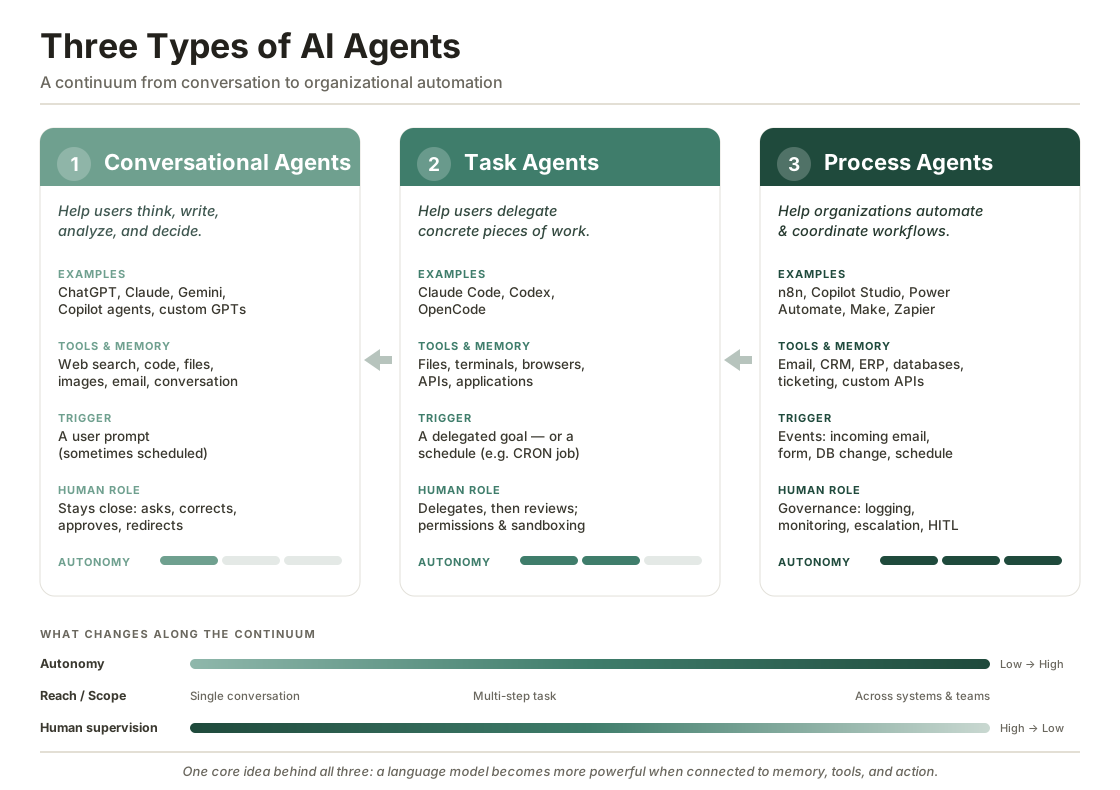
From this perspective, three broad types are especially useful: Conversational Agents, Task Agents, and Process Agents. Figure 2 summarizes this taxonomy as a continuum from conversation to organizational automation. I use this as a practical taxonomy rather than as a definitive scientific classification. The distinction is conceptual rather than empirical. It is meant to clarify design decisions, not to suggest that all real systems fit neatly into one box.
Conversational Agents
Conversational Agents are the most familiar form of agentic AI. They appear as conversational systems such as ChatGPT, Claude, Gemini, Microsoft Copilot experiences, or custom assistants built for a specific domain. At first glance, they look like traditional chatbots. The difference is that modern chat systems increasingly have access to tools, files, search, code execution, images, connected apps, or persistent user preferences.
The defining feature is not the user interface alone, but the relationship between human and system. The human remains close to the interaction. The user asks, corrects, approves, redirects, uploads missing context, and decides when the answer is sufficient. The agent may search the web, analyze a file, summarize a document, write code, or prepare a draft, but the interaction still unfolds as a conversation.
That means Conversational Agents are well suited for work in which the problem is not fully specified at the beginning. They help with thinking, writing, analysis, and decision preparation. A teacher might use a Conversational Agent to compare possible assignment formats. A student might use it to understand an error message. A manager might use it to structure notes from a meeting. In these cases, the agent contributes cognitive labor, but the human remains directly involved in steering and checking the work.
Conversational Agents can already be quite powerful. Through MCP or similar connector patterns, they can reach into local files, calendars, databases, or specialized tools (Model Context Protocol 2026). But the central trigger remains a user prompt, sometimes extended by scheduled prompts or recurring reminders. The main control mechanism is direct supervision in the conversation.
This also explains their limits. A Conversational Agent may support a complex decision, but it usually does not own the whole work process. It may generate a plan, but the user often has to execute or validate the steps. It may inspect a file, but it normally does not operate for hours across a repository, a browser, and a terminal unless the surrounding product has been designed for that mode.
Task Agents
Task Agents go one step further. They are designed for delegated work. The user does not only ask for an answer, but gives the agent a goal: analyze this repository, fix this bug, prepare this report, compare these documents, create the slides, or investigate why the build fails.
The practical difference is that a Task Agent operates over multiple steps. It can inspect context, plan a sequence of actions, use tools, observe results, revise its approach, and continue until the task is complete or human input is required. Coding agents are the clearest current example: systems such as Codex, Claude Code, or OpenCode work with files, terminals, tests, browsers, and version-control context. The same pattern also appears in document work, spreadsheet analysis, research assistance, and data workflows.
Here the main idea is delegation. The user still defines the goal and reviews the outcome, but the agent carries more of the intermediate work. This requires a different control model. Permissions, sandboxing, confirmations, and traceability become more important because the agent may change files, execute commands, call APIs, or interact with external systems.
OpenAI (2026) illustrates this shift at the framework level: it includes a managed agent loop, tool execution, sessions as memory, handoffs between agents, tracing, and human-in-the-loop capabilities. These concepts matter because task delegation is not just a longer chat. It is a runtime problem. The system needs to decide which action is allowed, what context is available, how intermediate results are handled, and when control returns to the human.
From my perspective, Task Agents are especially important for companies because they change what competent delegation looks like. Employees do not only need to write prompts. They need to review agent traces, assess tool use, understand generated artifacts, and decide whether the work process was appropriate. A coding agent that passes a test suite can still implement the wrong requirement. A research agent that produces a polished summary can still rely on weak sources. A data agent that runs an analysis can still leak information between training and test data.
This is why Task Agents require both trust and skepticism. They can reduce routine effort and make complex work more accessible, but they also make it easier to accept a plausible result without understanding the process that produced it.
Process Agents
Process Agents embed agentic AI into repeatable workflows and organizational processes. They are not primarily used in a one-to-one chat or on a single personal computer. Instead, they operate across systems, teams, and business processes.
Examples include AI-enabled workflows in n8n, Microsoft Copilot Studio, Power Automate, Make, Zapier, and comparable automation environments. n8n (2026) shows how language-model components can be used inside workflows, while Microsoft (2026) describes Copilot Studio as a graphical, low-code tool for building agents and agent flows with prebuilt or custom connectors. The specific products differ, but the architectural direction is similar: language-model reasoning is combined with workflow logic, application connectors, data access, and event triggers.
The main trigger is often not a prompt. A Process Agent may start when an email arrives, a form is submitted, a database entry changes, a support ticket is created, or a schedule is reached. The agent may classify information, retrieve customer data, draft a response, update a CRM, create a ticket, notify a team, request approval, or document the action taken.
The key difference is that the agent becomes part of an operational system. This increases potential value, but it also changes the risk profile. A mistake is no longer confined to a chat answer or a local file. It may affect customers, employees, records, permissions, or downstream systems. As a result, governance is not an optional add-on. It is part of the system design.
For Process Agents, human involvement usually moves from close conversational steering to governance. Humans define policies, approve sensitive actions, monitor logs, review escalations, and audit outcomes. The agent does not simply become “more autonomous” in a vague sense. Rather, autonomy is redistributed: routine decisions may be automated, while higher-risk cases require escalation or human approval.
A Continuum, Not Three Boxes
The three types should be understood as a continuum. A Conversational Agent may become more task-like when it gains access to files, tools, and persistent memory. A Task Agent may start from a conversational interface but then work for a while in a controlled environment. A Process Agent may include chat interactions, but its main role is to coordinate a workflow across systems.
This continuum matters because the same language model could appear in all three cases. What changes is the surrounding system: the context available to the model, the tools it can call, the trigger that starts the work, the duration of the activity, the degree of autonomy, and the control mechanisms around it.
In simple terms:
- Conversational Agents help users think, write, analyze, and decide.
- Task Agents help users delegate concrete pieces of work.
- Process Agents help organizations automate and coordinate recurring workflows.
The underlying idea is the same in all three cases: a language model becomes more useful when it is connected to memory, tools, and action. But usefulness does not scale automatically with autonomy. More tool access also means more ways to fail. More integration also means more organizational consequences. More automation also means a greater need for logging, monitoring, permissions, and clear responsibility.
This is consistent with recent work on agent evaluation and reliability. Kapoor et al. (2024) argue that current agent benchmarks often focus too narrowly on accuracy and pay insufficient attention to cost, reproducibility, and real-world usefulness. Rabanser et al. (2026) similarly argue that agent reliability cannot be reduced to a single success metric; consistency, robustness, predictability, and safety need to be examined separately. These concerns become more important as we move from conversational support to delegated task execution and then to organizational workflows.
What Changes Along the Continuum
The most visible change is autonomy. Conversational Agents usually act within a single conversational frame. Task Agents work across several steps, often with access to files, terminals, browsers, or applications. Process Agents can operate across systems and teams, sometimes triggered automatically by events.
The second change is scope. Conversational Agents usually support one user in one conversation. Task Agents handle a bounded piece of work. Process Agents affect repeatable workflows that may involve several systems, roles, and data sources.
The third change is the human role. With Conversational Agents, humans remain close. With Task Agents, humans delegate and review. With Process Agents, humans define policies, monitor behavior, and intervene through escalation paths. This does not mean that human judgment becomes less important. It changes where that judgment is applied.
The fourth change is governance. For a Conversational Agent, good practice may mean checking sources, protecting sensitive data, and reviewing outputs. For a Task Agent, governance also includes permissions, sandboxing, version control, test evidence, and action traces. For a Process Agent, governance must include organizational controls: access rights, logs, monitoring, rollback procedures, escalation rules, and compliance requirements.
Consequences for Companies and Use Cases
For companies, this taxonomy helps to avoid a common implementation mistake: treating “AI agents” as one generic technology category. The more useful starting point is the type of work that should be supported or automated. Exploratory knowledge work, delegated expert tasks, and repeatable operational workflows require different products, control mechanisms, and organizational capabilities.
The selection map in Figure 3 summarizes this decision logic. It does not prescribe a tool, but it helps to locate a use case before discussing vendors or architectures: the more repeatable and integrated the work becomes, the more the focus shifts from individual productivity toward process ownership and governance.
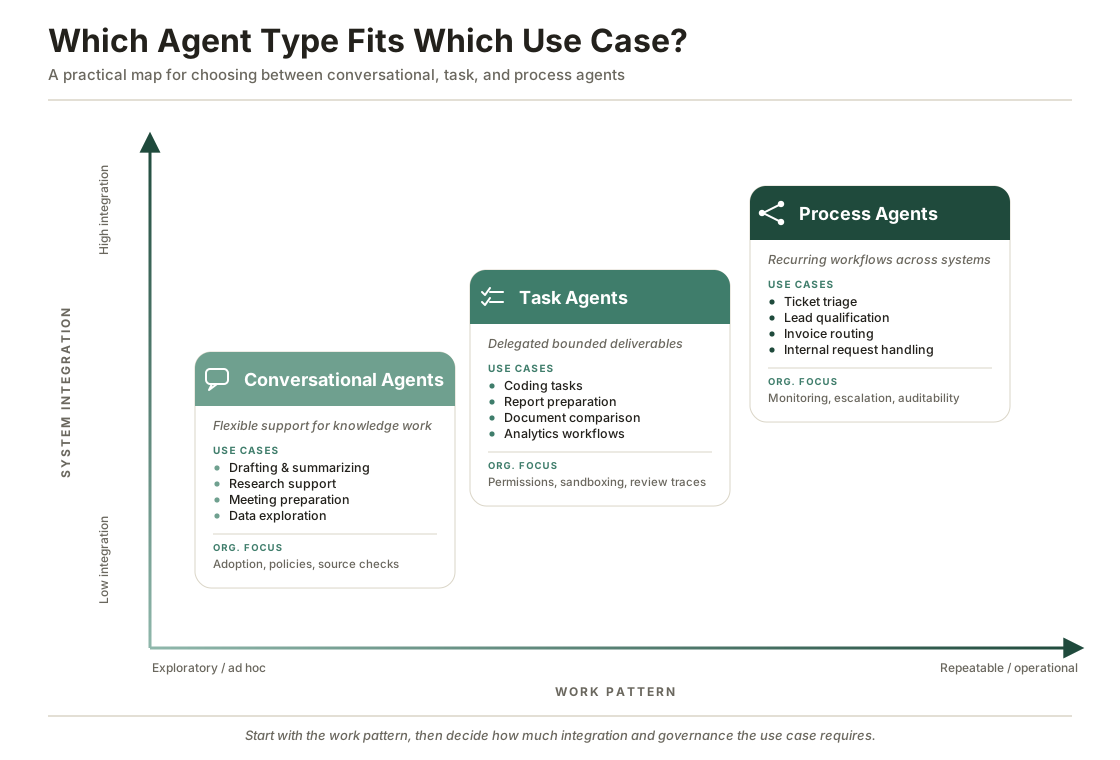
Conversational Agents are usually the right starting point when many employees need flexible support in knowledge work. Typical use cases include drafting and revising text, summarizing documents, preparing meetings, exploring data, translating between technical and non-technical language, and supporting ad hoc research. The main organizational focus should be adoption quality: clear usage policies, data-protection boundaries, source checking, prompt and review practices, and domain-specific knowledge access where appropriate.
Task Agents become relevant when a company wants to delegate bounded deliverables rather than only support conversations. This is especially plausible in software development, analytics, reporting, document preparation, quality checks, and internal research workflows. The focus should be on controlled execution: permissions, sandboxing, review steps, version control, test evidence, and traces of what the agent did. Task Agents are most useful where the organization can clearly define the goal and evaluate the result.
Process Agents are appropriate when the target is recurring operational coordination across systems. Examples include customer-service triage, lead qualification, invoice or document routing, ticket enrichment, internal request handling, HR onboarding steps, compliance pre-checks, and knowledge-based workflow automation. Here the decisive question is not whether the language model can produce a good response in isolation. The decisive question is whether the workflow can be operated reliably, monitored, escalated, and audited.
Additional Classification Dimensions
The taxonomy in this article classifies agents by their agentic role: Conversational Agent, Task Agent, or Process Agent. This is the central distinction. In company settings, however, three additional classification dimensions are useful because they explain why two systems with the same agentic role can still differ substantially in implementation effort, governance needs, and business impact:
- enterprise application embedding,
- operational integration depth, and
- AI value / maturity level.
Enterprise Application Embedding
The first dimension concerns the integration of AI into enterprise applications such as CRM, ERP, HR, service-management, procurement, or business-intelligence platforms. These integrations are important because many economically relevant workflows already live inside such systems. Customer records, orders, contracts, invoices, inventory data, support tickets, approvals, and audit trails are not external context. They are the operational environment in which work is coordinated.
It is useful to separate two aspects that are easy to conflate. Enterprise application embedding describes where the AI capability is placed: for example in a CRM, ERP, HR, service-management, procurement, or BI system. Operational integration depth describes what the AI is allowed to do inside or across those systems: read context, prepare bounded actions, update records, trigger follow-up steps, or coordinate recurring workflows. The fourth layer, AI value / maturity level, describes whether the capability primarily supports individual productivity, group productivity, business process efficiency, or business model transformation. The taxonomy still applies, but these additional layers explain how the same agentic role can have very different organizational implications.
Current vendor examples illustrate this range. Salesforce (2026) positions Agentforce as an AI-agent platform around CRM, service, sales, marketing, commerce, Slack, Data 360, and industry clouds. Microsoft (2024) describes autonomous agents in Dynamics 365 for sales, service, finance, and supply-chain teams, including examples such as sales qualification, supplier communication, and customer-knowledge agents. SAP (2026) presents Joule as an AI assistant embedded across SAP business applications, with the aim of supporting work in enterprise processes rather than sitting outside them. ServiceNow (2026) describes AI agents as embedded in its platform and connected to workflows, data, tools, and departments such as IT, HR, and CRM. These examples differ in product architecture, but they all show the same pattern: the agentic capability is placed close to system-of-record data and operational workflows.
For example, an AI assistant inside a CRM can function as a Conversational Agent if it helps a salesperson summarize an account, draft an email, or interpret recent activity while the user remains in control. The same CRM integration can become a Task Agent if the user delegates a bounded deliverable, such as preparing an account brief, checking duplicate records, enriching a lead profile, or producing a forecast explanation for review. It becomes a Process Agent when CRM events trigger coordinated follow-up steps: lead scoring, account assignment, ticket creation, record updates, escalation, notification, and documentation.
The same logic applies to ERP systems. A conversational assistant that explains a purchase order or summarizes open invoices is closer to a Conversational Agent. A delegated check that compares invoice data, flags inconsistencies, and prepares a review note is closer to a Task Agent. A workflow that reacts to an incoming invoice, validates it against purchase orders, routes exceptions, updates records, and logs decisions is closer to a Process Agent.
Enterprise application embedding therefore cuts across the taxonomy. It often makes agents more useful because it provides structured data, domain context, and action surfaces. Operational integration depth determines how far this usefulness extends into actual work execution. Once an agent can read or update records in core systems, the relevant questions include role-based access, data lineage, approval thresholds, auditability, rollback, and ownership of exceptions.
Operational Integration Depth
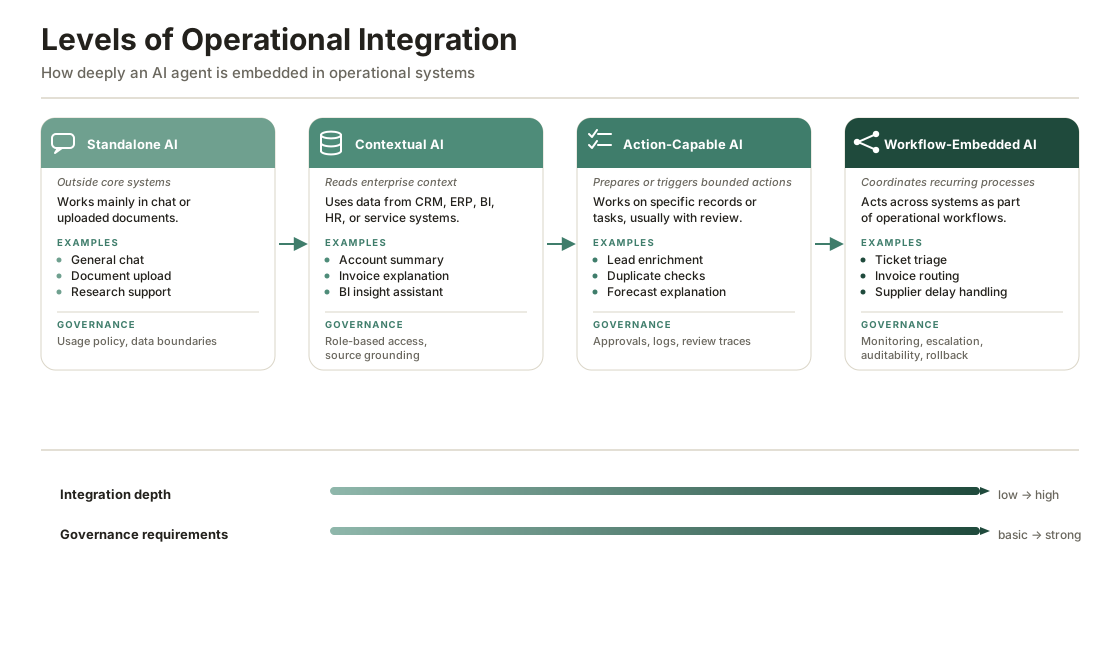
This gives companies two dimensions for prioritization: the agentic role and the operational integration depth. A low-integration Conversational Agent can often be introduced as a broad productivity tool, even if it occasionally uses enterprise context. A Task Agent inside a CRM or ERP system already requires clearer permission boundaries and review processes. A Process Agent that updates core records or coordinates workflows across systems requires process ownership, monitoring, escalation, and auditability from the beginning.
The operational integration ladder in Figure 4 makes this second dimension explicit. It separates low-risk standalone use from contextual access, bounded action, and workflow-level embedding. This distinction is useful because the governance requirements usually increase with operational integration depth, even if the underlying language-model capability looks similar.
AI Value / Maturity Level
This third additional dimension connects the agent discussion to a broader value perspective. He and Puranam (2026) describe an AI maturity pyramid that starts with individual productivity, moves through group productivity and business process efficiency, and only then reaches business model transformation. This is not an agent taxonomy. It classifies the level at which an AI capability creates value. Many Conversational Agents primarily operate at the individual productivity level. Task Agents can support individual or group productivity, depending on whether the delegated work remains personal or becomes part of team workflows. Process Agents usually move the discussion toward business process efficiency because they are embedded in recurring operational work.
Figure 5 summarizes this value perspective as a pyramid. The important point is not that every company must climb it in a fixed sequence. Rather, the figure helps separate two questions: which agentic role a system takes, and at which organizational level the AI capability is expected to create value.
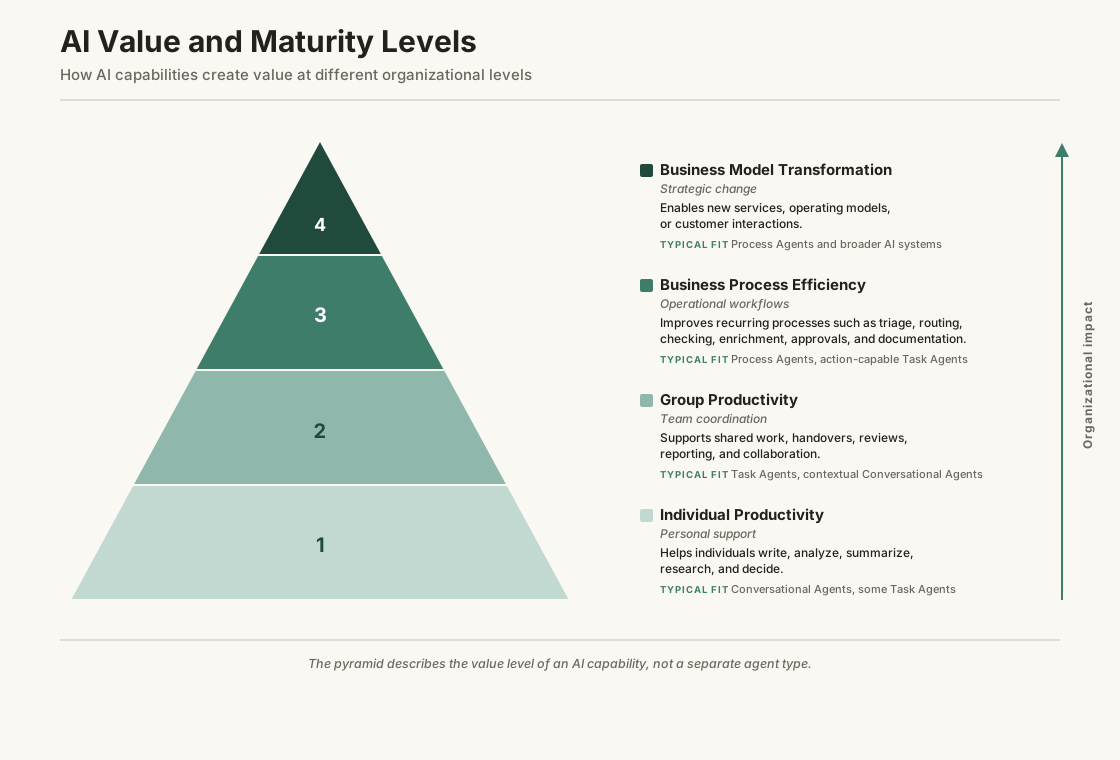
The table below summarizes the four layers. The main topic of this article remains the first layer: the agentic role. The other layers help explain where the agent is embedded, how deeply it is integrated into operations, and at which value or maturity level the AI capability creates impact.
| Classification layer | Main question | Typical scale | What changes in practice |
|---|---|---|---|
| Agentic role | What kind of work does the agent perform? | Conversational Agent -> Task Agent -> Process Agent | Trigger, autonomy, scope, and human supervision |
| Enterprise application embedding | Where is the AI capability placed? | CRM, ERP, HR, service management, procurement, BI | Available business context, system permissions, and user workflow fit |
| Operational integration depth | What is the AI allowed to do in operational work? | Standalone -> Contextual -> Action-capable -> Workflow-embedded | Data access, write permissions, auditability, rollback, and process ownership |
| AI value / maturity level | At which value level does the AI capability create impact? | Individual productivity -> group productivity -> process efficiency -> business model transformation | Individual assistance, team coordination, process improvement, or strategic transformation |
Different companies will therefore start at different points in the taxonomy. Small organizations or teams at the beginning of their AI adoption often benefit most from strong Conversational Agent use and a few carefully selected Task Agent pilots. Companies with mature data access, API infrastructure, and process ownership can move faster toward Process Agents. Highly regulated organizations should usually proceed more slowly, starting with internal, low-risk workflows and explicit human approval for consequential actions.
The taxonomy also supports procurement decisions. If a vendor mainly offers a chat interface, it should be evaluated as a Conversational Agent even if it uses the language of autonomy. If a tool can inspect files, run commands, and produce artifacts, the evaluation must include execution controls and review quality. If a platform connects CRM, ERP, email, ticketing, and databases, the procurement process must involve process owners, IT, security, legal, and operations from the beginning.
From my perspective, the most important point is that “agent” should not be treated as a product label. It should be treated as a design question. The relevant issues are what is delegated, which context is available, which tools can act, who reviews the result, and what happens when the agent is wrong. These questions are more useful than asking whether a system sounds sufficiently intelligent to deserve the agent label.
For companies, this leads to a simple way of using the taxonomy. First, clarify whether the intended use case supports individual work, delegates a bounded task, or coordinates a recurring process. Second, determine how deeply the system should be embedded in existing applications such as CRM, ERP, service management, or analytics platforms. Third, define the governance model before the agent is allowed to read sensitive data, update records, trigger workflows, or make consequential recommendations. These three questions do not replace technical evaluation, but they make the evaluation more concrete.
Conclusion
Conversational Agents, Task Agents, and Process Agents describe three useful points on a continuum from conversation to organizational automation. They are built from similar ingredients: a language model, context, memory, tools, and control logic. What differs is where the agent operates, how much autonomy it receives, how it is triggered, and how human supervision is organized.
The practical consequence is straightforward. We should not evaluate an agent only by the quality of its final response. We should evaluate the whole working arrangement: the tools, permissions, traces, review points, failure modes, and organizational consequences. The more an agent moves from conversation toward process automation, the more this system view matters.