Hallucination Is Not One Problem – It’s Two
Three types of error and two places to fix them: what hallucination rates measure and where each problem can be solved.
“Language models have practically stopped hallucinating.” I keep reading this claim on LinkedIn at the moment. Sometimes it comes with a screenshot of a leaderboard where the best model sits below two percent, sometimes with a Stanford study according to which fabricated references fell from 55 percent with GPT-3.5 to almost zero. Both numbers are correct. They just measure different things, and each has different consequences in practice.
Part of the reason is the word itself. “Hallucination” sounds like a single kind of error. In fact it covers several, with different causes, fixed in different places.
Three Types of Error
I distinguish three (Figure 1).
Source unfaithfulness. The model has a source in front of it and still asserts something that is not in it.
Miscalibration. The model does not know the answer and answers anyway instead of admitting it.
Confabulation. The model lacks knowledge and fills the gap with something that sounds plausible. Neuropsychology coined the term for patients who unconsciously fill memory gaps with invented memories, with no intent to deceive. It fits language models better than “hallucination”, because there is no perceptual disorder involved.
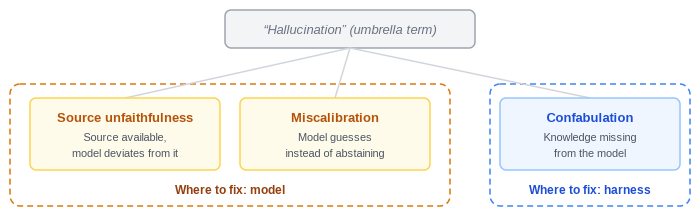
In practice, what matters most is where you can intervene. There are only two places: the model itself, or the system built around the model, meaning retrieval, tools and control logic. That system has come to be called the harness, and we use the term in our book as well (Bücker and Hewing 2027). Three types of error, two places to fix them. Hence the title.
Source Unfaithfulness: What the 1.8 Percent Measures
The figure below two percent comes from the Vectara Hallucination Leaderboard (Vectara 2026). In October 2026 it lists 111 models with rates between 1.8 and 24.2 percent. The procedure is simple. A model receives a document and summarizes it. A second model checks which statements in the summary are supported by the document. Whatever cannot be supported counts as hallucination.
So what is measured is faithfulness to a source, and models have become much better at it. Belem et al. (2025) looked at a harder case. They had models summarize several documents on a topic that appeared in none of them. The correct response would have been to say that the documents contain nothing on it. GPT-3.5-turbo still produced a summary in up to 79 percent of cases, GPT-4o in up to 44 percent. The experimental setup was the same for both. The difference lies in the model.
The reverse holds as well. Even in the best retrieval pipeline, GPT-3.5 would invent content here that is not in the documents. The harness can deliver the right source. Whether the model sticks to it is not up to the harness.
About the case without a source, the leaderboard says nothing. Whether a model knows where the seat of government of Madagascar is, and whether it admits not knowing, is not measured there.
Miscalibration: What Happens Without a Source
Other benchmarks cover that, for example OpenAI’s SimpleQA. It consists of short factual questions and scores whether a model answers correctly, answers incorrectly or abstains. In an analysis from September 2025, OpenAI compares two of its own models (Kalai et al. 2025):
| gpt-5-thinking-mini | o4-mini | |
|---|---|---|
| Abstention | 52 % | 1 % |
| Correct | 22 % | 24 % |
| Incorrect | 26 % | 75 % |
Both are right about equally often, 22 and 24 percent. Their knowledge is therefore similar. The difference lies in the rest. o4-mini almost never abstains and is wrong in three quarters of cases. gpt-5-thinking-mini says in more than half of cases that it does not know the answer.
The ability to judge one’s own uncertainty correctly is called calibration. How good a model is at it depends on training. OpenAI names the mechanism itself: the usual benchmarks reward guessing. A guessed answer at least has a chance of scoring a point, an “I don’t know” is certain to score none. Models optimized for such benchmarks therefore learn to guess.
The best-known example is fabricated references. The model knows no suitable source and names one anyway, complete with author, year and journal. For GPT-3.5, earlier studies put the share of fabricated references at 55 percent. That is the figure from the Stanford study mentioned at the start. Queen and Zou (2026) re-tested 50 widely cited findings about language models on 20 newer models, this one among them. For GPT-6.1 Sol the share has dropped to almost zero, and the finding counts as “expired” there. Qwen3.7-Flash, also released in 2026, still fabricated 69 percent of its references.
So calibration can be trained. But it does not arrive automatically with the next model generation. It depends on what a vendor optimizes for.
Confabulation: Where the Harness Helps
With the third type of error, the system around the model can actually achieve a great deal. Many agentic systems work with retrieval-augmented generation (RAG) or similar mechanisms. Before the model answers, the agent searches a knowledge base or the web. The model is just one building block among several (Figure 2).
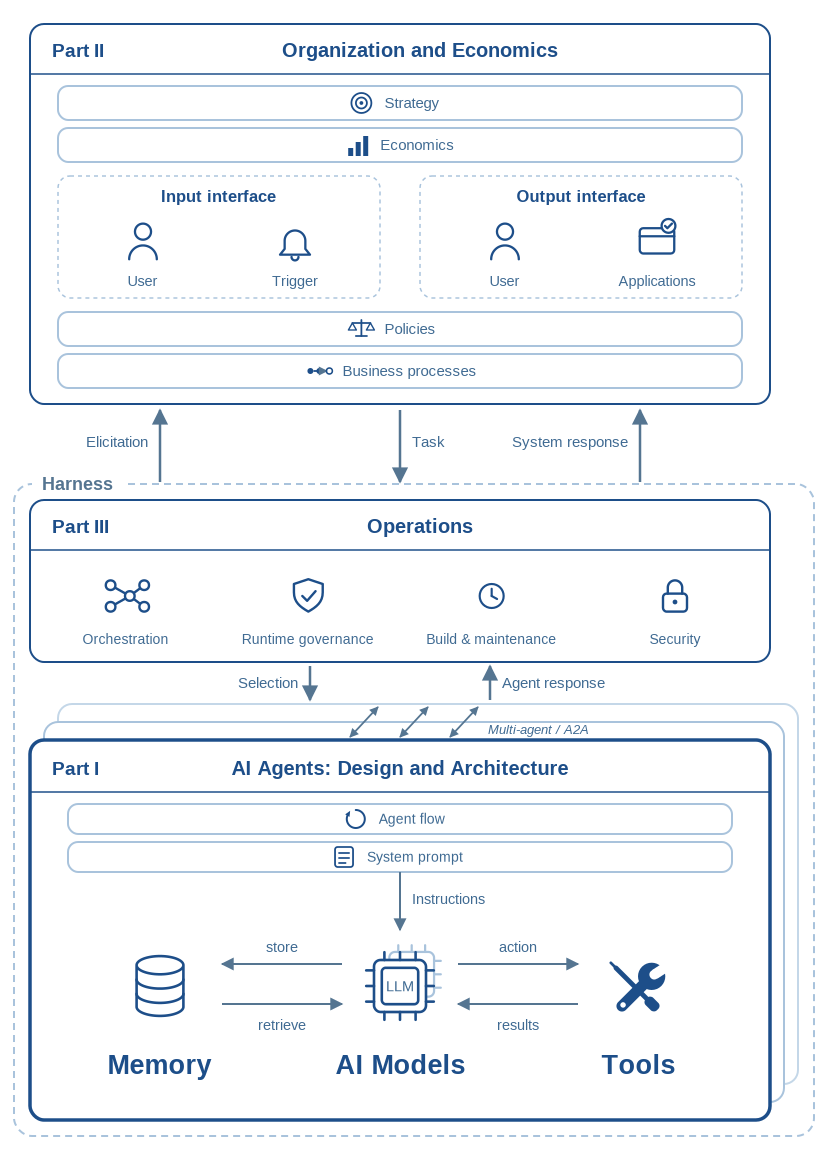
Ask an agent about an event after its training cutoff, and it can search for it. The same applies to rare facts, current figures and internal documents. The model does not need to hold any of this in its weights, it only needs to receive it. How the different forms of memory work together is described in “Where Does an AI Agent’s Memory Actually Live?”, and which types of agents are involved in “Three Types of AI Agents”.
Confabulation does, however, need two ingredients: a knowledge gap and a model that does not admit it. The harness closes the gap. Admitting it remains the model’s job, and that is the miscalibration from the previous section. And as soon as the harness delivers a source, the problem becomes one of source faithfulness. That, too, only the model can provide.
Conclusion
Anyone claiming that language models no longer hallucinate usually means one of the three types of error without saying which. Vectara measures source unfaithfulness, SimpleQA measures miscalibration. A good result in one test says little about the other.
So I ask two questions of every hallucination figure. Was it measured with or without a source? And: Does it score abstention, or only accuracy? Without these two details, a number says little about whether a system can be trusted in use.
The distinction between model and harness runs through the book on AI agents that Michael Hewing and I are publishing with Springer Nature: AI Agents: Designing, Orchestrating, and Governing LLM-Based Systems comes out on 24 February 2027. More at aiagentsbook.org.